 LUMAVIR
Does scalp massage help hair growth?
Research shows promise, but the evidence is limited and small. Two studies stand out in the published literature, and both have real limitations you should know about.
The most-cited study comes from 2016, published in Eplasty. Researchers recruited 9 men and asked them to use a mechanical scalp massager for 4 minutes daily over 24 weeks. Hair thickness increased in the treated group compared to baseline. That's a measurable result, but a sample size of 9 is tiny. It tells us massage can influence hair, not whether it will work for you or at what scale.
A 2019 survey published in Dermatology and Therapy tracked 340 participants who performed twice-daily scalp massages using a standardised technique. About 69% reported their hair loss had stabilised or improved based on self-assessment. Self-reported outcomes are weaker evidence than measured hair thickness, but the larger sample is encouraging. The caveat: people motivated enough to massage their scalp twice daily may also be managing stress better, eating better, or making other changes. We can't isolate massage alone.
Massage won't regrow a receded hairline or reverse androgenetic alopecia (male or female pattern baldness) on its own. The studies show only a small effect on thickness in small groups, likely via mechanisms we understand only partly. If you're looking for a reason to massage your scalp, they give you one. If you're hoping to reverse hair loss, you need medical evaluation first.
How scalp massage might work
The theory rests on three things: blood flow, cell signalling, and stress.
When you massage your scalp, you increase blood circulation to the hair follicles. Better blood flow means better nutrient and oxygen delivery to the papilla cells at the follicle base, which are responsible for growing hair. This is plausible and supported by animal studies, though human data directly measuring this effect is sparse.
Mechanical stimulation itself may matter. Stretching and moving the scalp tissue stimulates the dermal papilla cells through mechanoreceptors. In animals, similar stimulation has triggered growth factors. In humans, we see the endpoint (thicker hair in the 2016 study) but not the cellular pathway, so this remains theoretical.
Stress reduction could play a role. Massage is relaxing, and chronic stress can push hair into the shedding phase (telogen effluvium). If massage reduces stress and stress reduction halts excessive shedding, that's a real benefit, even if it's not "growth" in the traditional sense. None of the studies measured cortisol, so we're inferring this from the mechanism and from the fact that relaxation does lower stress hormones.
All three together offer a biologically plausible explanation. None of it will work if you have a thyroid problem, iron deficiency, or genetic hair loss proceeding unchecked.
How to massage your scalp for hair growth
The 2016 study that showed the best result used a standardised technique: 4 minutes daily, consistent pressure, systematic coverage. Here's how to replicate that approach with your fingertips or an electric device.
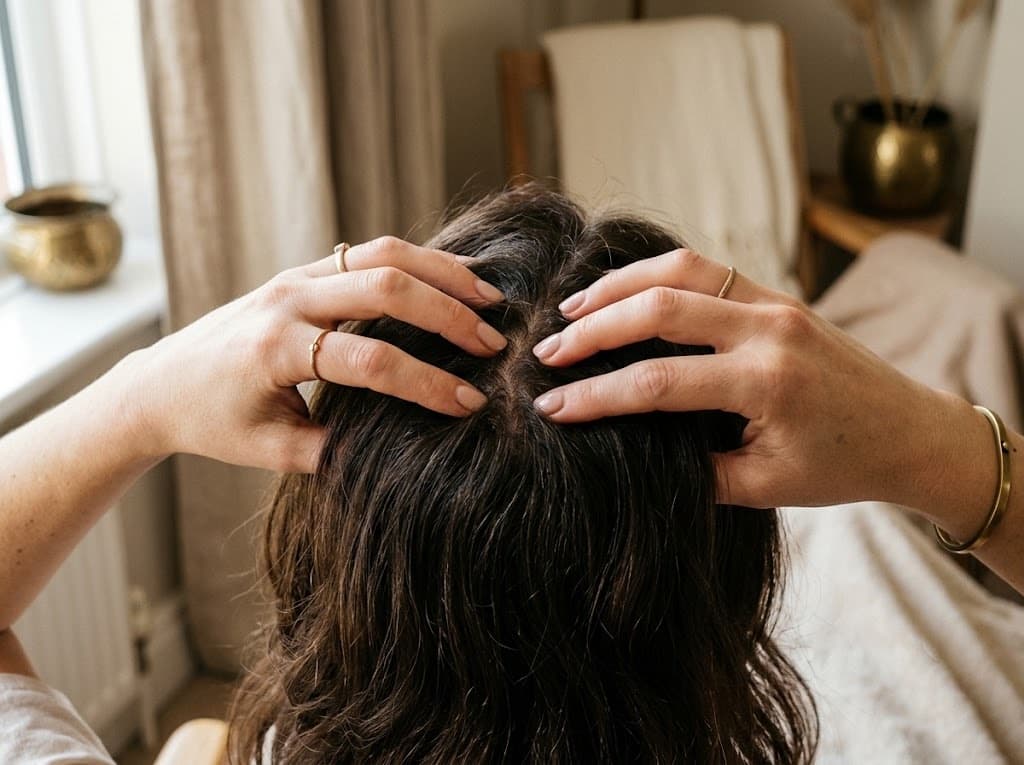
Fingertip circular method
This is the evidence-backed approach. Spend 4 minutes on this routine daily, ideally at the same time each day to build the habit.
- Position: Start at your hairline, just above your eyebrows. Use the pads of all four fingers (not nails) on each hand.
- Pressure: Apply light to medium pressure. You should feel it, but it shouldn't hurt. Pressing too hard can irritate the scalp; too light won't engage the tissue.
- Motion: Use small circular motions, about the size of a coin. Move in place for 2-3 seconds, then shift to the next area.
- Coverage: Work in lines across your scalp from front to back. Cover your hairline, temples, crown, and sides. The back of your head near the nape is often tight and benefits from extra attention.
- Duration: Spend about 1 minute on each of four zones: (1) front and temples, (2) sides, (3) crown, (4) back.
Aim for consistency over intensity. Four minutes every single day is more effective than a 20-minute weekend session.
In-shower method
If you're already shampooing, add scalp massage while conditioner is on.
Apply the same circular, light-to-medium pressure technique to your damp scalp while your conditioner or a scalp treatment is in. You're doing the same work, just timing it when you're already there. Water and product make the massage smoother and prevent tugging on hair. This method works well if you find it hard to stick to a separate routine, because it's anchored to something you already do.
Fingers, brush or electric scalp massager: which is best?
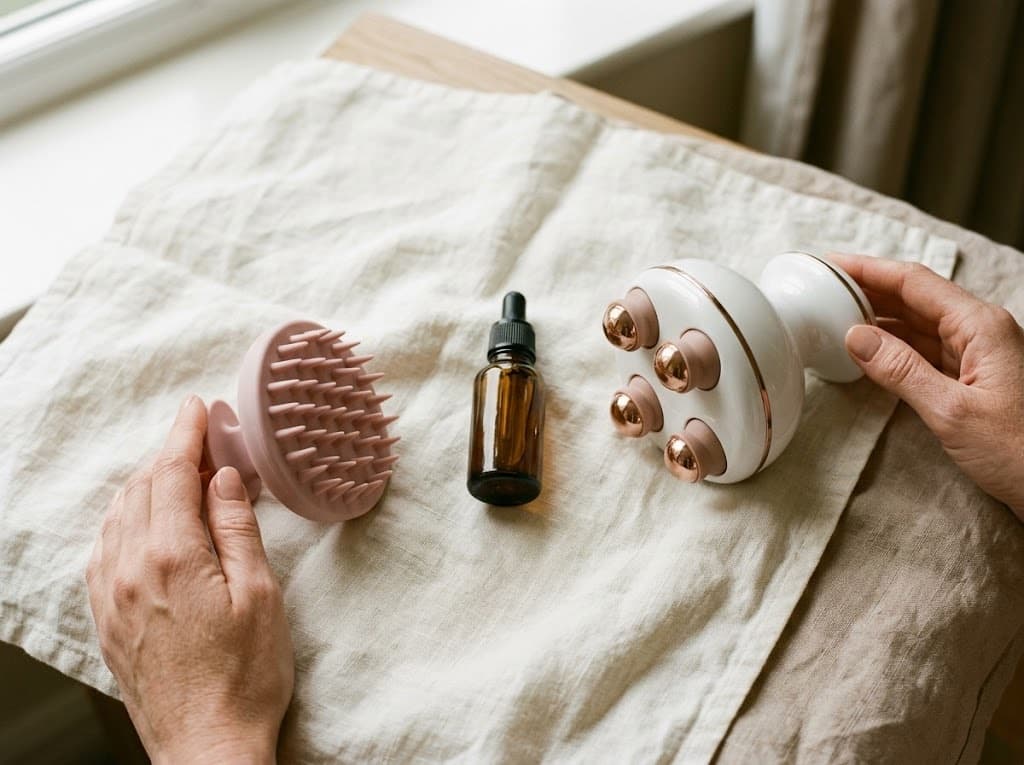
A disclosure before the comparison: Lumavir sells two of the tools below, so read this as a practitioner's view rather than an independent review.
| Method | Cost | Evidence Base | Pros | Cons |
|---|---|---|---|---|
| Fingertips | Free | Direct (Koyama study used standardised technique, not a device) | No extra equipment; evidence-backed technique; tactile feedback | Requires discipline; hand fatigue; inconsistent pressure |
| Silicone Brush | £4-10 | Indirect (similar pressure and coverage to hands) | Gentle; lathers in shower; easy to use; affordable | No head-to-head studies vs hands; easier to over-press |
| Electric Massager | £30-80 | Indirect (Koyama study used a mechanical device, so the principle is proven; no direct comparison to hands) | Consistent pressure; hands-free; easy frequency and timing control; effortless | More expensive; requires charging; risk of over-use if you enjoy it too much |
The Koyama study itself used a mechanical scalp massager, which tells us that device-based massage can work. No published study has directly compared electric massagers to manual massage in humans, so we cannot say one is objectively better. If you like using a device and will do it consistently, that edge is everything.
For hair-care tools, we stock the Lumavir Electric Scalp Massager for standard massage and the Lumavir Microcurrent Scalp Comb if you want added microcurrent stimulation. Both deliver consistent pressure. What matters most is using one regularly, not which one you pick.
How often and how long until you see results
Most guides promise results in weeks. The data doesn't support that.
Weeks 0-4: Nothing visible. Your hair is growing, but the effect is at the cellular level. Don't expect to see density changes this soon. Use this phase to establish the habit and stop looking in the mirror every day.
Weeks 4-12: Possible stabilisation if hair shedding is your main problem. Shedding may slow, but you won't see new density yet. Hair growth is slow: each follicle grows about 0.3-0.4 mm per day, meaning a single hair grows roughly 1 cm per month. Thickness changes need multiple growth cycles.
Weeks 12-24: The 2016 study measured thickness at 24 weeks. If you're going to see a measurable difference, this is the timeline. Even then, it's subtle. Expect a change you'd notice in a good photo from the same angle, not a dramatic visual shift.
Beyond 24 weeks: If massage is helping, benefits should plateau around this point and stabilise with continued use. If you see no change by week 16-20, massage alone may not be your answer, and you should talk to a trichologist or dermatologist about other factors (deficiencies, hormonal, medical).
Hair cycles matter here. A full hair cycle lasts 2-7 years depending on genetics and health. Massage won't speed that up. It may improve the hair growing during that cycle, but you're working within biological constraints.
Scalp massage benefits beyond hair growth
Hair thickness is the most studied benefit, but other effects are worth noting.
Scalp massage relaxes the muscles at the base of your skull and across the scalp, reliably triggering a relaxation response. Stress is a known driver of temporary shedding (telogen effluvium), so breaking that cycle has real value. If massage helps you decompress for 4 minutes daily, that's a win even if hair thickness never changes.
Light scalp massage may ease tension at the occipitalis and across the temples. It won't treat migraines or serious headaches, but for tension-type headaches, it can complement other strategies.
Massaging your scalp stimulates sebaceous glands and improves oil flow from the scalp down the hair shaft. If your scalp is dry or your hair ends are splitting, this helps. If your scalp is oily, use very light pressure and avoid the scalp itself; focus on the hair instead.
These benefits are harder to measure than hair growth, but they're real for most people and reason enough to adopt the habit, regardless of hair outcomes.
Who scalp massage won't help (and when to see a professional)
Advanced androgenetic alopecia. If you have male or female pattern baldness that's progressed significantly, massage alone won't recover lost hair. Androgenetic alopecia is genetic and hormonal. It needs medical intervention: minoxidil (Regaine), finasteride (Propecia), or professional treatments like platelet-rich plasma or hair transplants. Massage can support these treatments as a complement, but it cannot replace them.
Alopecia areata. Patchy, sudden hair loss is likely autoimmune, not mechanical. See your GP immediately. Massage may help with stress, which is relevant here (stress can trigger flares), but it won't address the underlying immune problem. Your GP can refer you to a dermatologist.
Scarring alopecia. If hair loss comes with scalp scarring, inflammation, or redness, this is a medical condition. Stop massaging and see a dermatologist. Continued trauma can worsen scarring alopecia.
Sudden or rapid shedding. If you're losing noticeably more hair than normal over a few weeks (telogen effluvium, anagen effluvium from medical causes, or nutritional deficiency), see your GP. Massage won't address the cause. Your doctor will test for thyroid function, iron, and other deficiencies.
Alongside minoxidil or finasteride. If you're already using evidence-based treatments for hair loss, massage is a safe adjunct. It won't interfere, and the relaxation is a bonus. It's not a replacement for medical treatment.
If your hair loss is sudden, scarring, patchy, or progressive despite lifestyle changes, it's medical. See a professional. Massage is a preventive and supportive habit for people with healthy hair who want to maintain thickness or slow age-related thinning, not a treatment for hair disease.
When not to massage your scalp
Several conditions make scalp massage inadvisable until they're resolved.
Active psoriasis or eczema flare. Massage can irritate inflamed skin and trigger itching cycles. Wait until the flare settles, then resume gently.
Fungal infection. Massage spreads fungal spores and worsens the infection. Treat with antifungal shampoo (your GP can prescribe or recommend), then wait 2-3 weeks after symptoms clear before resuming.
Broken skin, cuts, or open sores. Don't massage over wounds. You risk infection and pain. Wait for healing.
Recent scalp surgery or hair transplant. The post-operative protocol says no massage for several weeks. Pressure on the graft or suture sites impairs healing. Follow your surgeon's timeline, typically 2-4 weeks minimum.
Severe scalp pain. If your scalp is painful to touch, massage will make it worse. See a doctor to rule out infection or other causes.
Frequently asked questions
- Do scalp massages really stimulate hair growth?
- Small studies (n=9 in the most-cited trial) show massage can increase hair thickness, likely via improved blood flow and mechanical stimulation of follicle cells. A 2019 survey of 340 participants found 69% reported stabilisation or regrowth. The evidence is promising but limited. Massage works slowly and works best for maintaining hair thickness, not reversing hair loss. It is not a treatment for male or female pattern baldness on its own.
- How often should you massage your scalp?
- The research supports daily massage for 4 minutes. Consistency matters more than duration. A daily 4-minute routine outperforms sporadic longer sessions. In the 2016 study, participants massaged daily for 24 weeks before measurable thickness changes appeared. Commit to it as a daily habit anchored to an existing routine (e.g. while you shower or brush your teeth).
- What are the disadvantages of a scalp massager?
- Electric massagers can encourage over-use if you enjoy them too much, potentially irritating the scalp or causing tenderness. They require charging. They are more expensive than using your fingertips. Some people find the vibration sensation uncomfortable. For these reasons, starting with your fingertips is safer; you can switch to a device later if you want consistency and hands-free convenience.
- Should I use oil for scalp massage?
- Oil is optional. A small amount of coconut oil, argan oil, or your regular conditioner can reduce friction and make the massage feel smoother. It's not required for efficacy. If you have oily scalp, skip oil and massage with dry scalp or just water. If you use oil, focus it on the hair shaft and ends, not the scalp itself, unless your scalp is very dry. Oils can be heavy and trap bacteria if overused on the scalp.
- How long does it take to see results?
- Expect no visible change for 4-8 weeks. Possible subtle stabilisation of shedding by week 12. Measurable thickness changes typically appear around 16-24 weeks of consistent daily massage. The 2016 study measured results at 24 weeks. Hair grows slowly, so patience is essential. If you see no change by 20 weeks, massage alone may not be your answer, and you should consult a dermatologist about other causes.
Consistent massage beats intensive effort
The evidence supports daily 4-minute massage, and an electric scalp massager removes the inconsistency that stops most people. The Lumavir Electric Scalp Massager is £22.99 with free UK shipping and a 14-day money-back guarantee, so there is time to settle into the habit before you commit.
Sources
This guide cites the Healthline scalp massage for hair growth guide, which covers the Koyama et al. (2016) study published in Eplasty showing increased hair thickness from 4-minute daily massage, and a 2019 self-assessment survey of 340 participants published in Dermatology and Therapy. For hair loss and when to see your GP, refer to the NHS hair loss guidance.