Free UK shipping on every order · 14-day money-back guarantee
Track your order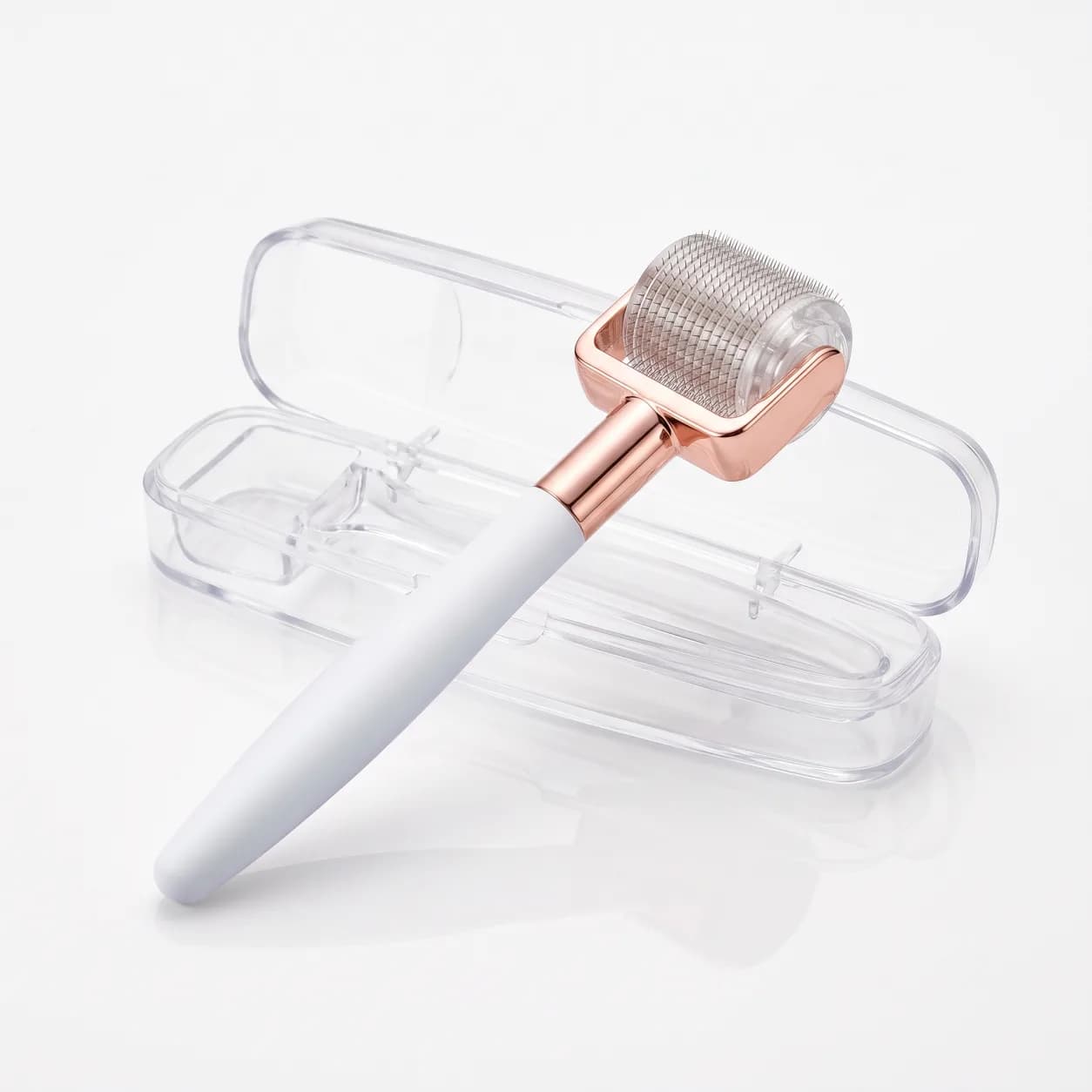
Low Stock
Skincare
Written and reviewed by the Lumavir beauty-tech team. We research the at-home beauty devices we sell and keep every product detail factual and current. Last updated July 2026.
£11.99
A 0.5mm derma roller for face, beard and scalp. It is a cheap tool that does very little harm if you use it properly and quite a lot if you do not, so the hygiene section below is the important part of this page.
Bundle & Save
1 Piece
£11.99
£14.39
2 Pieces
You get 31% off!
£20.00
£28.78
3 Pieces
You get 33% off!
£29.00
£43.17
Lumavir sells at-home beauty tools, and this is the one where the instructions matter more than the product. It costs less than a takeaway. Getting it wrong costs more.
What it is: a handheld roller covered in very fine needles, used in a technique called microneedling. Rolled over the skin it creates microscopic punctures, which the skin responds to by repairing itself, and which temporarily let serums sit in micro-channels rather than on the surface. That is the mechanism, and it is real. The size of the effect is where listings start exaggerating.
Needle length is the single most important number here, and this one is 0.5mm for a reason. Healthline's guidance is that 0.25mm to 0.5mm is the at-home range, suited to product absorption and fine lines, while lengths of 1.0mm to 2.0mm are generally recommended for professional use by dermatologists only. Longer needles are not a stronger version of the same thing, they are a different risk profile: deeper punctures, real bleeding, longer downtime and a genuine scarring risk if you get it wrong. If a marketplace listing offers you 1.5mm for £5.45, which several currently do, that is not a bargain.
On what it actually achieves, Healthline's assessment is that derma rollers "can help smooth out skin texture and reduce pigmentation" and that "professional-grade procedures may be necessary for significant improvements". So: modest, gradual, and not a substitute for what a clinic can do. It will not erase scars, whatever the listings on this search page say.
The hair and beard question is the biggest part of the demand and deserves a straight answer. Microneedling the scalp is a genuine area of interest, and it is often studied alongside a topical treatment rather than on its own, which makes it hard to say what the rolling contributes by itself. We are not going to tell you this regrows hair. If hair loss is your actual concern, a GP or a registered trichologist is a better first spend than a £12 roller, and the treatments with the strongest evidence behind them are medical.
Hygiene is where cheap derma rollers cause actual harm, so read this bit. You are making hundreds of small openings in your skin. A roller that has not been properly sanitised puts whatever is on it into those openings. Healthline's guidance is to soak the roller in 70% isopropyl alcohol for five to ten minutes before and after every use, and to limit use to two or three times a week. Needles also blunt with use, and a blunt needle tears rather than punctures, so rollers are consumable and need replacing rather than keeping forever.
We checked the UK search results for "derma roller" in July 2026 and the market is mostly very cheap. Marketplace rollers run £2.50 to £7, mid-market ones are £8 to £14, and clinic or salon-brand rollers reach £19.99 to £24. We priced this at £11.99, in the middle, and we would rather you spent that than £2.50 on something you will be pressing into your own face.
Healthline places 0.25mm to 0.5mm in the at-home range and 1.0mm upwards in professional hands. This sits at the top of what is sensible to use on yourself.
the micro-channels are temporary, and they let a product you already own sit in the skin rather than on it.
the same tool covers the three things people actually buy it for.
needles blunt with use, so a roller is a consumable. At £11.99 replacing it when it dulls is not a painful decision.
Modestly, and within limits. A derma roller creates microscopic punctures that trigger the skin's own repair response and temporarily open channels for skincare products to absorb through. Healthline's assessment is that derma rollers "can help smooth out skin texture and reduce pigmentation", while noting that "professional-grade procedures may be necessary for significant improvements". Expect gradual texture change over weeks, not scar removal.
Needle length decides almost everything about the risk. Healthline puts 0.25mm to 0.5mm in the at-home category, aimed at product absorption and fine lines, and says 1.0mm to 2.0mm is generally for professional use by dermatologists. This roller is 0.5mm, deliberately at the top of the home range rather than beyond it.
The part that decides whether it helps or hurts is hygiene. You are opening the skin, so anything on the roller goes in. Sanitise it in 70% isopropyl alcohol for five to ten minutes before and after every single use, do not share it with anyone, do not roll over active acne, cold sores, eczema or broken skin, and replace it once the needles dull. Two to three uses a week is the ceiling. More is not faster.
Soak the roller in 70% isopropyl alcohol for five to ten minutes before use.
Cleanse the area thoroughly and dry it. Never roll over makeup or product residue.
Roll gently in vertical, horizontal and diagonal directions, around ten to fourteen passes per area. Light pressure only.
Lift the roller between directions rather than dragging it across the skin in an arc.
Apply a simple serum afterwards. Skip acids, retinoids and vitamin C immediately after rolling, since the skin is more permeable.
Sanitise the roller again, let it air dry, and store it in its case.
Derma Roller 0.5mm
£11.99
 LUMAVIR