 LUMAVIR

LED masks use visible light rather than ultraviolet light, but devices, settings and users differ. A short session may feel uneventful for one person and uncomfortable for another, particularly around the eyes or on reactive skin. Whether masks work at all is a separate question, answered in our evidence guide on whether LED face masks work.
LED face mask side effects: what is common?
The side effects reported most often are temporary redness, warmth, irritation or discomfort. The American Academy of Dermatology's red-light safety guidance describes common effects as mild, while a randomised trial of red LED exposure reports reactions under its tested protocol. Reports vary by device and person, so this list cannot predict how your skin will respond.
A little warmth during or just after a session can happen, especially when a mask sits close to the face. Your skin may look flushed for a short time. Mild tightness or dryness can also reflect the rest of your routine, such as cleansing or active ingredients, rather than light alone. Make one change at a time and note when the sensation starts and how long it lasts.
Bright light near the eyes can cause strain, headache or discomfort for some users. Fit, brightness and the colour mode matter. If your eyes feel sore, you develop a headache, or your skin becomes increasingly itchy or irritated, end the session. Do not try to push through a reaction to complete the timer.
Pause use and seek medical advice for blistering, swelling, significant pain, a rash that spreads, vision changes, or redness that persists or worsens. If a new or changing lesion is under the mask, do not cover it with a device as a substitute for getting it assessed. An LED mask is a cosmetic device, not a way to diagnose or manage a skin condition.
LED face mask side effects and eye safety
Protect your eyes exactly as the manufacturer directs. Keep your eyes closed if the instructions say so, use supplied shields or recommended goggles, and do not look directly at illuminated LEDs. Eye protection needs vary by wavelength and output, so sunglasses are not a substitute for equipment named in the manual.
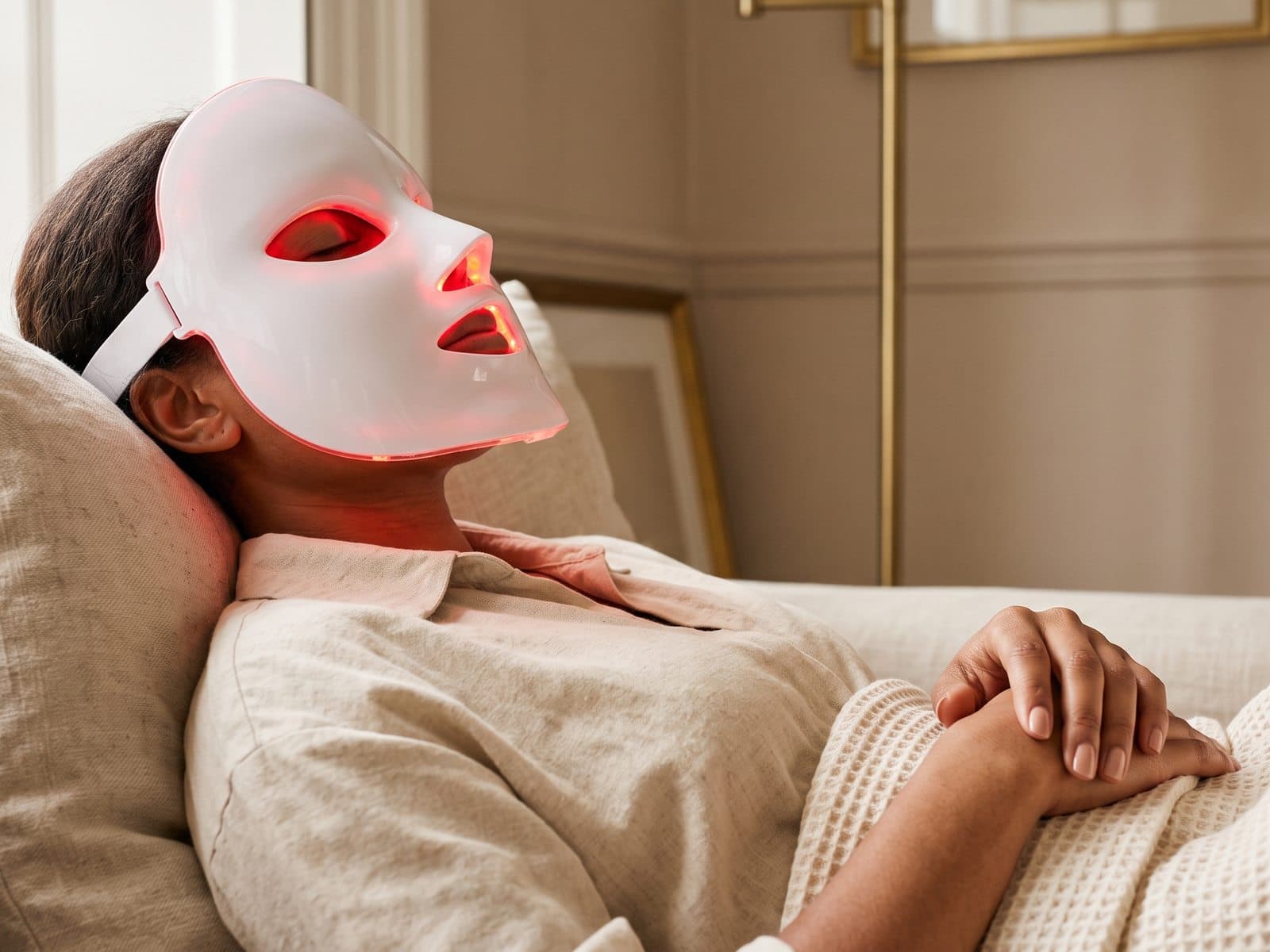
Red light and blue light are both visible, but that does not mean they have identical eye effects. Some masks have built-in eye openings or shields, while others sit closer to the eye area. Read the setup instructions before switching on, check that shields sit correctly, and do not assume closed eyelids provide the protection a particular device requires. The American Academy of Dermatology advises following the device directions on eye protection and using the recommended protection.
Stop immediately for eye pain, blurred vision, persistent after-images or unusual light sensitivity. If symptoms do not settle after stopping, contact an optometrist or another appropriate clinician. People with a diagnosed eye condition, a history of retinal disease or unusual light sensitivity should ask an eye-care professional before trying a mask, especially one designed to sit over the eye area.
A dedicated eye-area device has different placement and intensity instructions from a full-face mask. For example, the Lumavir LED eye mask uses red and near-infrared light, has five intensity levels and a built-in timer. Its own manual should guide its use; do not apply a full-face mask schedule or eye advice to it.
Who should not use an LED mask without advice?
Ask a GP, pharmacist or dermatologist before use if you take a medicine that can increase light sensitivity, have a light-triggered condition, an eye disease or an active skin problem. They can advise whether your health and treatment are compatible with the specific device.
Some medicines are photosensitising. Examples include certain tetracycline antibiotics such as doxycycline and oral retinoids such as isotretinoin. The risks depend on the medicine and the type of light exposure. Read your patient information leaflet and ask a pharmacist or prescriber whether the specific mask is suitable. Do not stop, delay or alter a prescribed treatment to use a beauty device. Topical retinoids and exfoliating acids can also make skin more prone to irritation, so ask the prescriber who knows your routine before combining them with a mask.
If you have photosensitive epilepsy, check with your epilepsy team before using a device that flashes, flickers or cycles through colours. Epilepsy Action notes that LED lights are not a common trigger unless they are flashing, but research is not complete and triggers differ. A steady light is not the same as a strobe, yet a colour-changing mode or faulty flicker deserves caution. Stop if the light causes symptoms and do not test your tolerance alone.
Pregnancy is another reason to ask first: there is limited direct safety information for consumer face masks in pregnancy, and devices differ. People with active rashes, broken skin, infection, a history of skin cancer or an unexplained mark should also seek clinician advice before treating that area. If you have a diagnosed condition such as eczema, rosacea or melasma, check with your clinician rather than using a mask over a flare.
Blue light, darker skin and pigmentation
Visible blue light can affect pigmentation, so people with darker skin or melasma may want extra caution with blue mode. A controlled study of repeated blue-light exposure found pigmentation changes in its study population. Those conditions do not tell us the exact risk from every home mask.
The concern is a possible increase in uneven pigmentation, including darker marks after irritation. It is not a reason to assume every blue LED mask will cause a change, nor is a product claim about a particular colour enough to establish safety for your skin. If you have melasma, a history of post-inflammatory hyperpigmentation or medium to deep skin, ask a dermatologist whether blue light is appropriate. You could choose not to use blue mode while you get advice.
Watch for a new dark patch, a change in an existing mark or a clear difference after sessions. Stop the device if this happens and arrange an assessment if the change persists. Do not attempt to correct a pigment change by increasing session frequency or layering extra exfoliating acids. Our UK LED face mask guide and budget LED mask guide cover choosing a device; neither can replace individual advice for a skin condition.
How often to use an LED face mask
Follow the frequency and session length in your exact device manual. There is no safe universal schedule for all LED face masks because models differ in wavelengths, output, fit, timer and intended use. More frequent or longer sessions do not automatically mean better results, and the instructions are the upper boundary for routine use.
Some consumer masks recommend a few short sessions each week; others have a different schedule. Lumavir's seven-colour face mask guidance describes around 10 to 15 minutes per session, a few times a week. That is product-specific guidance, not a prescription for another mask. If your model recommends a daily session, follow its own time limit. If its manual is missing, unreadable or does not identify how to use the device, do not guess: contact the seller or choose a product with clear instructions.
Start at the lowest intensity if the manufacturer provides adjustable levels and recommends a gradual start. Keep a simple note of the date, mode, duration and any reaction. Avoid doubling a missed session or adding an extra mode to catch up. If redness, tenderness or eye discomfort recurs, take a break. Resume only if symptoms have settled and the instructions or a clinician indicate it is reasonable.
The Lumavir seven-colour LED face mask has seven visible-light modes, including red and blue, and its product guidance describes short sessions on clean, dry skin. Use the supplied manual for the final schedule and keep sessions within its timer. What the research says about results is in do LED face masks work?
Using LED with retinoids, acids and other skincare
Use a mask on clean, dry, intact skin unless its manual says otherwise, and avoid adding a new active ingredient at the same time as starting light sessions. Separating changes makes it easier to identify the cause if irritation appears.
Retinoids and exfoliating acids can cause dryness, stinging or peeling on their own. Some topical treatments are also associated with light sensitivity, and medicine effects are specific to the ingredient. Check product leaflets and ask a pharmacist or prescriber about combining a photosensitising treatment with LED. Avoid applying a strong active immediately before a session unless the device maker or your clinician has advised that routine. If skin is already raw, inflamed or freshly treated, wait until it has settled and ask for advice where needed.
Do not use an LED mask as a treatment for acne, eczema, rosacea, infection or another diagnosed condition. If a condition is getting worse, pause cosmetic devices and speak with a clinician. While checking for irritation, stick to familiar products and avoid adding several new items at once.
Cleaning, hygiene and heat precautions
Clean the mask after each use using the method in its manual. Many devices should be wiped with a soft, dry or slightly damp cloth, but materials and electrical parts vary. Do not rinse an electronic mask under a tap, use alcohol or harsh cleaners unless the maker explicitly permits it, or share a face-contact device without cleaning it between users.
Check the surface and strap before use. Stop if a cracked casing, exposed wiring, damaged cable, unusual smell or unexpected heat appears. Keep charging equipment dry and use only the supplied or specified charger. A device that feels hot, causes burning or leaves a persistent imprint is not something to tolerate for the sake of finishing the session.
Let your skin cool between skincare steps if it feels warm, and avoid using a mask over sunburn, a fresh peel, waxing irritation or broken skin. Heat is not the intended goal of visible-light use. If warmth shifts into burning, pain or increasing redness, remove the mask and stop.
Buying safely: instructions matter as much as a mark
Choose a seller that identifies the manufacturer, supplies clear English instructions, explains eye protection and session limits, and offers a way to ask product questions. Avoid listings without a manual, usable contact details or information about the light modes. Without those details, you cannot make an informed choice about using the device.
UKCA or CE markings may apply depending on the product regulations, but a logo alone is not a guarantee that a device is suitable for you or that its claims have been independently tested. UK government guidance says the required conformity marking depends on the rules for that product, and instructions must be clear and understandable. Check that the product has the marking required for its category, along with manufacturer details and safety instructions.
Read our best LED face masks guide for buying considerations and compare the manual, eye protection and return terms before ordering. If your questions are about medication, pregnancy, a skin diagnosis or your eyes, ask a relevant health professional rather than relying on a retailer listing.
Sources and evidence limits
This guide draws on dermatology advice, medical references and controlled studies. A study of one wavelength or exposure is not a direct safety test of every home mask. The American Academy of Dermatology's red-light safety advice recommends following device directions and using specified eye protection. Randomised trials of red LED exposure and a controlled study of blue-light pigmentation report findings under specific exposure conditions.
For medicine and flicker cautions, see DermNet's review of drug-induced photosensitivity and Epilepsy Action's information on photosensitive epilepsy. For product checks, see the UK government pages on consumer product safety and UKCA or CE marking in Great Britain. Long-term safety data for consumer masks remain limited, so this page avoids treating absence of reported harm as proof of no risk.
How we wrote this guide
The Lumavir team wrote this guide from the dermatology guidance and published studies linked above and from the instructions supplied with our LED masks, and checked it on 18 October 2026. We sell the masks mentioned here and have not run clinical tests of our own, so treat this as general information, not medical advice. If you spot an error or a source that has changed, email info@lumavir.com and we will correct it.
Frequently asked questions
- Are LED face masks safe to use?
- Many people can use an LED face mask safely when they follow its manual, but suitability depends on the person and device. Ask a clinician or pharmacist before starting if you take medicine that causes light sensitivity, have an eye condition or a condition triggered by light, or are pregnant. Stop if you develop pain, persistent redness or a change in pigmentation, and seek advice if symptoms continue.
- How often should you use an LED face mask?
- Use the schedule written for your exact model and mode. Manufacturers set different session times, and a routine from another mask may not suit yours. Lumavir's seven-colour face mask guidance suggests around 10 to 15 minutes a few times a week; check your supplied manual for the instructions that apply to your device. Adding sessions will not make the prescribed schedule safer.
- Can you use an LED mask every day?
- Daily use is appropriate only when the manufacturer allows it for your exact mask and setting. Some manuals set a weekly limit, while others give a different routine. Keep to the stated session time and frequency. If daily use brings on irritation or eye discomfort, stop using the mask and ask a clinician for advice if the symptoms persist.
- Do LED face masks damage your eyes?
- An LED mask can cause eye discomfort, and the protection needed depends on the device and its light output. Follow the manual, use the supplied shields or goggles as directed, and never stare into the LEDs. Closed eyelids may not provide the protection your mask requires. Stop for pain, blurred vision or unusual sensitivity, and contact an eye-care professional if symptoms persist.
- Who should avoid LED face masks or ask a clinician first?
- Ask a GP, pharmacist or dermatologist before using a mask if you take a medicine that increases light sensitivity, have an eye disease or a condition triggered by light, are pregnant, or have an active or unexplained skin change. Medicines such as some antibiotics and oral retinoids need individual advice. Keep taking prescribed treatment as directed, and check the patient leaflet and mask manual with your clinician.
- Are LED face masks safe for darker skin or melasma?
- Blue light can increase pigmentation in some skin types, although controlled exposure studies cannot establish the risk from every home mask. If you have darker skin, melasma or a history of dark marks after irritation, ask a dermatologist whether blue mode is suitable. Stop using it if a patch darkens or you notice a lasting change in your skin tone.
- Are LED face masks safe long term?
- Long-term safety evidence for consumer LED masks is limited. Dermatology guidance describes common short-term effects as mild, but devices and settings vary, and that does not establish the effects of years of use. Follow your manual and note recurring reactions. Pause if symptoms build over time, and ask a dermatologist to assess persistent redness, sensitivity or pigmentation changes.
Choose a device with clear instructions
Review the product details and supplied instructions before starting. UK delivery is free, with estimated delivery of 6 to 8 business days. Returns are available within 14 days; change-of-mind return postage is paid by the customer.